
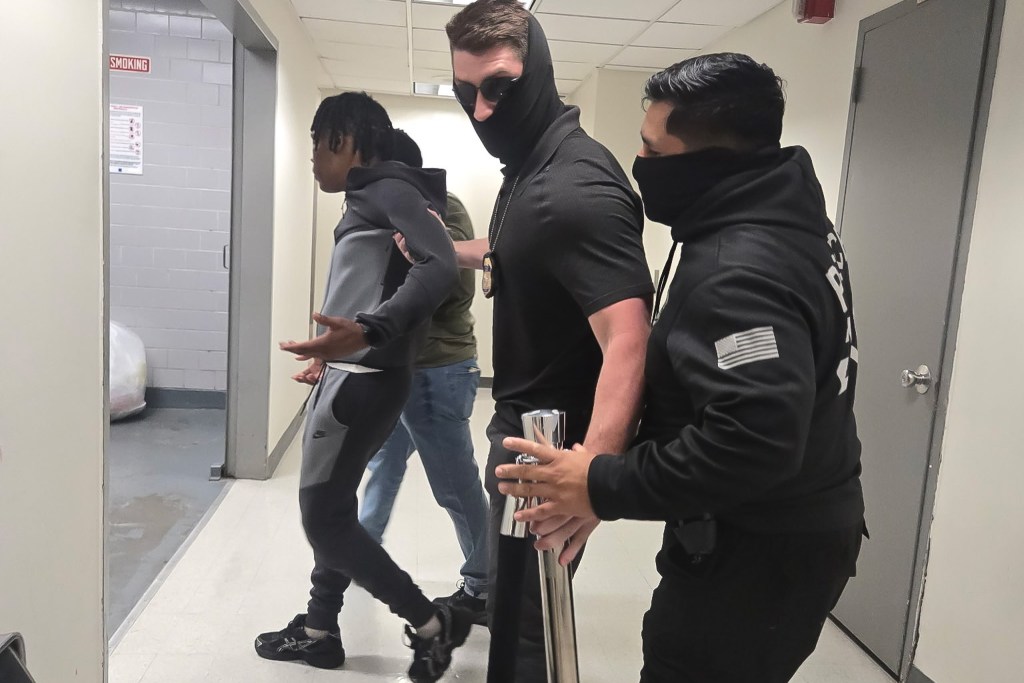
Immigration and Customs Enforcement officers arrested at least five people inside New York City immigration courts in recent weeks, despite two federal court orders banning the practice in most cases.
Advocates are asking a federal judge to step in, saying the arrests may violate those orders. In response, in court filings this week, ICE justified the arrests by citing the criminal histories of those targeted.
“At-large arrests in sanctuary cities like New York tend to trigger protests and intervention by agitators and bystanders, making alternative locations in New York unsafe and [the Executive Office of Immigration Review] the safest location for the arrests,” wrote Roberto Rodriguez, an Acting Supervisory Detention and Deportation Officer for ICE in a declaration filed Monday night. “ICE believes that a safe alternate arrest location does not exist or it would be too difficult to effectuate the arrest at an alternate location.”
The justification echoes language from ICE’s 2021 guidance, reinstated by a judge’s order in May, which allowed courthouse arrests in rare cases of a threat to national security, “an imminent risk of death, violence, or physical harm to any person,” or a “hot pursuit” of an “individual who poses a threat to public safety.”
That Biden-era policy also said that even without a hot pursuit, ICE could arrest someone considered a threat to public safety inside immigration court if “a safe alternative location for such action does not exist or would be too difficult to achieve the enforcement action at such a location.”
Two of these recent arrests occurred on June 25 and were captured on video by photographer Christina Panagi. Attorneys from the advocacy group Make the Road New York promptly sued on both men’s behalf seeking their release. Three of these arrests were previously reported on by The Intercept.
In a June 29 letter, attorney Katherine Rosenfeld, who is representing African Communities Together and other immigrant groups, asked Judge Kevin Castel, the federal judge overseeing ongoing litigation about ICE’s courthouse arrest policy, to step in.
“Plaintiffs have become aware of five courthouse detentions in Manhattan immigration courts, all of which have raised serious concerns about Defendants’ compliance,” Rosenfeld wrote. “ICE has also maintained a heavy presence in those courthouses on a near-daily basis, which contributes to precisely the intimidating effect that this Court found constitutes irreparable harm to plaintiffs.”
In their reply Monday, ICE laid out their new justification for these arrests — two of which they said occurred at 26 Federal Plaza and three at 290 Broadway — which they argue are not in violation of Judge Castel’s order.
Rodriguez cited the criminal histories of the five people targeted in the immigration courthouse arrests and said ICE queries arrest databases and makes a list of arrest targets ahead of their immigration court hearings, though the declaration did not provide specifics in any of the cases.
“In evaluating the EOIR immigration court as the location for the arrest as opposed to another feasible location, ERO views the EOIR immigration court as one of the safest locations in which an arrest could be conducted,” he wrote.
A spokesperson for ICE provided further detail on three of the arrests saying one of the men had a trespassing conviction, a second had a third degree assault and criminal obstruction of breathing charge, and a third had assault and attempted murder charges pending. The agency didn’t return a request for comment right away about the fourth and fifth arrests.
“ICE did NOT violate any court orders. These were lawful arrests,” the spokesperson wrote in a statement.
The City Reporter was able to corroborate one of these three criminal charges with the Bronx District Attorney and state court records. In that case, ICE arrested a man on June 29 inside immigration court at 290 Broadway who was accused of slicing another man on the head with a large kitchen knife in May and was later released while assault charges against him were pending.
In her letter to Judge Castel, Rosenfeld highlighted another one of the cases, where the man’s only criminal history was a trespassing charge related to his initial entry into the United States in 2024.
“Since then, he has complied with immigration supervision; appeared for immigration-court hearings at least three times; and had no contact with the criminal system,” Rosenfeld wrote, adding she thought his arrest “appears to flout” Judge Castel’s order.
“The government cannot reasonably contend that an individual whose sole criminal history stems from a charge arising from his entry into the United States poses a threat to public safety, necessitating his arrest at an immigration courthouse, particularly when he has been fully compliant with immigration authorities since that time,” she wrote.
The back and forth follows Judge Castel’s ruling on May 18 that struck down the Trump administration’s policy of targeting immigrants en mass inside immigration courthouses, a tactic that The City Reporter showed was more prevalent in New York City than any other major city.
With masked ICE agents walking the hallways for months starting last May, these arrests sent shockwaves across the city’s busy immigration court, and forced immigrants to make an impossible calculation — showing up to court and risking arrest, or skipping their hearings and being subject to immediate deportation orders.
Castel’s ruling followed a striking development in the months-long litigation over the policy, where federal prosecutors walked back much of their earlier justifications for immigration courthouse arrests, admitting ICE had no policy in place to justify the practice.
In late June, a federal judge in California issued a similar ruling that barred most of these arrests nationwide.
But neither of these rulings barred immigration courthouse arrests outright. Instead they forced ICE to revert to earlier guidance in effect under the Biden Administration from 2021 that laid out certain caveats for when immigration courthouse arrests would be allowed.
Our nonprofit newsroom relies on donations from readers to sustain our local reporting and keep it free for all New Yorkers. Donate to THE CITY today.
The post ICE Finds New Justification for Immigration Courthouse Arrests, Despite Court Orders appeared first on The City Reporter.
